

DMA Defined, 30/04/2026
Three not-entirely-happy years for the Digital Markets Act 😬

EU’s Digital Markets Act gets an average review score, like Balan: Wonderworld
Xbox to become more “affordable, personal and open”, says bigwigs
Housemarque’s Saros delivers shooty fun in the week’s releases.
Hello VGIM-ers,
An easy introduction this week because I have two (2) things to tell you about.
First, the Power Play tour ticket page has gone live for your purchasing amusement.
The page has direct ticket links for the first four dates of the book tour – Hay-on-Wye, Balham, Cambridge and Norwich – for you to hit. It will also be updated every time a new date gets added. Join me at one of those dates by grabbing your spot here.
Second, and I ask you to remain calm about this, there will be no VGIM next week.
I am going on holiday before all the book madness truly kicks in. And the only way I can take proper time off is by punting all my work, including newsletter writing/editing, into the sea for a bit.
You may get one short email from me next week promoting a future VGIM event. But if you’re looking for a full-fat newsletter, you’ll have to wait until the 14th May.
The big read - DMA Defined
Keep calm: Hurry! Wake the kids! It’s here! Yes, the most exciting day of the video game and policy year has arrived: the European Commission’s first review of the effectiveness of the Digital Markets Act (DMA).
It is 14, going on 15 (pages): Ok, there’s not really any way I can dress a relatively dry 14-page policy document up as anything other than, erm, a relatively dry 14-page policy document. But the DMA matters for the games biz. Its rollout in 2023 shifted the competitive landscape of the global industry, cracking open app stores in Europe and sparking waves of similar legislation in Brazil, Japan, India and the UK.
A little bit complicated: So two years on from platforms meaningfully changing to adapt to the new rules, has the DMA delivered what it said it would for Europe? And is it likely to deliver ongoing benefits for games companies, or shift its focus elsewhere? According to the Commission, it’s doing a tip-top job. But for everyone else who is regulated under the law, isn’t marking their own homework and works in the games biz, it’s a little more complicated than that.
A quick run-through
Jerry good performance: The Commission announced the findings of its review on Tuesday 28th April. In its press release accompanying the publication of the report, it said: “the DMA remains fit for purpose and has opened up new opportunities for businesses and developers.” Teresa Ribera, Executive Vice-President for Clean, Just and Competitive Transition, said the DMA “has begun delivering tangible, positive results” for European citizens. And Hennu Virkunen, the Commission’s Executive Vice-President for Tech Sovereignty, Security and Democracy, claimed it had delivered “concrete changes for innovators and citizens.” These comments reminded me of the episode of Rick and Morty where clones of Jerry, Morty’s inept Dad, immediately start shaking hands with one another after a misjudged attempt to sound heroic.
Setting out the terms: So let’s ignore the spin for a second and examine the review against its own terms. On its opening page, the Commission restates the DMA’s purpose to provide “a targeted set of harmonised rules applicable to digital platforms with gatekeeper position.” It aimed to make “digital markets in the EU fairer and more contestable” by getting dominant Big Tech players who control the infrastructure of the internet – like search engines or app stores – to stop using their market dominance to behave unfairly. By designating certain enormous platforms as ‘gatekeepers’ and slapping them with duties to stop being so naughty, the Commission hoped that cracking open digital markets would turbocharge business innovation and give more rights to people across Europe. It also hoped that Big Tech would live with one set of EU-wide obligations, rather than run the risk of 27 countries writing laws all on their lonesome.
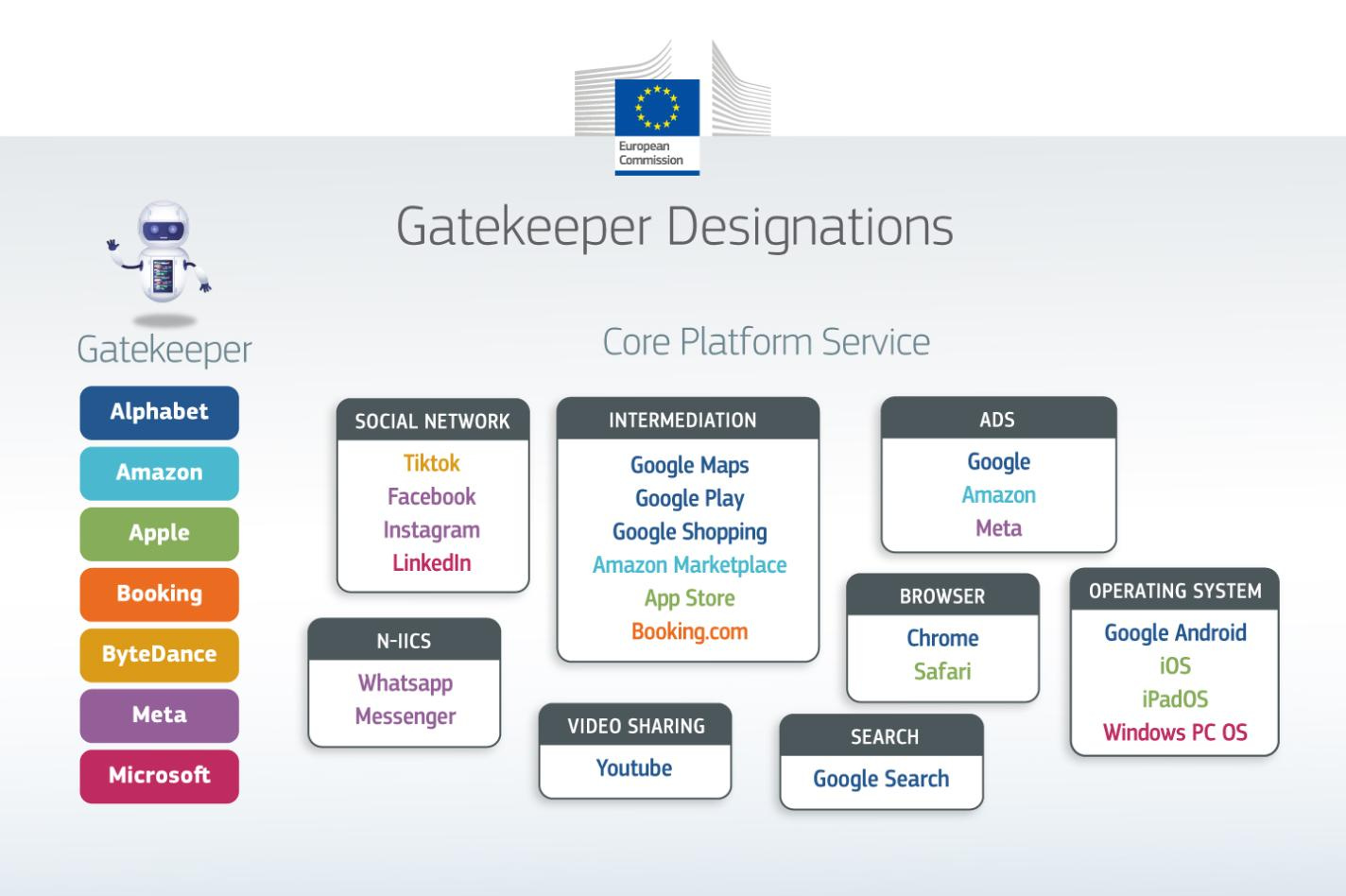
Gatekeeping: Between 2023 and 2026, the Commission identified seven gatekeepers (Alphabet, Amazon, Apple, Booking, ByteDance, Meta and Microsoft) running 23 core services that fell under the act across the continent. Many of these services serve the games industry, including the app stores (Google Play and the App Store), digital advertising platforms (Google, Amazon and Meta), social media platforms that drive game discovery (TikTok as a prime example) and operating systems (including Android, iOS and Windows). All were meant to follow best practices like allowing their platforms to easily work with other services, increasing the amount of data businesses can pull from them and allowing companies to point to offers or services outside the platform. They were also meant to stop naughtiness from gatekeepers, like promoting their own products more favourably.
Big benefits?: At this point, the report begins to identify general benefits that the DMA has delivered. It highlights a noticeable uptick in the number of alternative browsers and app stores available to businesses and consumers via previously locked platforms. It celebrates that users can now ditch pre-installed apps, download interaction data from social media more easily and cross-pollinate their data from platforms with a wider array of services. It shows that there is greater transparency in areas such as advertising cost and effectiveness via platforms, or through regular annual reporting from gatekeepers into their practices.
They fought the law and the law kinda won: The Commission also tips its hat to the enforcement actions it has launched through the DMA, including efforts to stop Apple and Google from preventing businesses ‘steering’ customers away from their stores to alternative platforms (a big deal for game companies seeking to sell direct to consumers). It goes on to argue that it believes the DMA prevented a costly counterfactual scenario, where fragmented efforts to strengthen rights in digital markets across the bloc would prove hella complicated for all involved.
Keeping a low-profile
Someone is shy: Yet despite all this, there’s definitely something a bit odd about the review. It is oddly vague for a big assessment of a landmark law. Some of its ‘big’ successes seem laughably small, such as the less-than-impressive announcement that 40 companies have used data portability rules to roll out new features. It’s also curiously shy in places, burying the details of high-profile Big Tech enforcement action that had been celebrated with noisy media releases in the footnotes.
Dodging the drafts: The circumspection has a few root causes, said a couple of Brussels-based contacts whom I hit up over WhatsApp. The first is that the Commission always ends up drafting its review documents like this. The urge to self-congratulate clashes with a need to be evenhanded as part of a formal three-year process. The result is a document similar to the Commission’s first review of the effectiveness of GDPR in 2020: an exercise in half-hearted boosterism that eventually gave way to a less positive second review that sparked efforts to tweak the rules.
Bully boys: There’s more to it than a clash in drafting though. One contact made it clear that the absence of detail is almost certainly a by-product of the Commission’s ongoing clashes with Trump’s Big Tech-backing administration. Until late 2024, the EU’s legislative moves were considered a global regulatory backstop. After Trump arrived, businesses have been emboldened to criticise the DMA either directly through companies like Amazon or via trade associations like the Computer & Communications Industry Association, whose bread is richly buttered by the same companies. Big Tech has some reasonable fears about the nature of the DMA, including getting locked into a form of double jeopardy where they’re regulated under both its rules and separate national laws. But the strength of their criticism shows that they think Trump’s more muscular (read: idiotic) approach to Europe could force concessions, encouraging the Commission to keep its head down.
Missing its potential: But perhaps more importantly than that, there is simply a question of whether the rules are actually that effective at all. The Commission is keen to celebrate its wins, but on page nine it states that the act has “still not reached its full potential”. It says that while it has had a “real positive impact”, it also states that the DMA is still so wet behind the ears that its impact can’t fully be measured yet. And given that the scope of the act has completely missed cloud computing and AI services (the latter, admittedly, which exploded after the horse-trading over the act), the review leaves a dangling question of how much meaningful value the DMA has delivered in the 1000 or so days since it rolled into law.
Playing with the rules
Some good news: And so we arrive at whether the DMA has been handy for the games business. Based on the review, which doesn’t mention games once, you might guess it hasn’t. But actually, it’s somewhat more positive than that.
In on the games: Fortnite’s return to the app stores across Europe was a result of the law, something Epic Games keenly communicated. Forcing the bad boys of Big Tech to allow developers to use third-party services like payment providers has significantly opened up the direct-to-consumer model, meaningfully boosting revenues for game developers able to steer customers to their own stores. The act also encouraged companies to bring their own app stores to mobile, even if Epic’s store has struggled a bit (and Microsoft’s mobile store ambitions seem to be fading by the day).
Limited impact: However, the DMA’s overall usefulness to games companies remains in question. Jari-Pekka Kaleva, President of the European Games Developer Federation, gave the DMA one tick of approval for its enforcement actions when he examined a review in a post on LinkedIn. By contrast, he suggested that improvements to access to alternative infrastructure and data portability rights only amounted to a ‘half measure’ of success. He would go on to criticise the DMA for failing to capture many services in games that are essentially gate-kept (e.g. game engines), for failing to provide truly transparent data access and for not successfully defending democratic norms. He went on to suggest that the Commission was “still moving too slowly” and that it was necessary to prod them further.
DMA long road ahead: So two years on, the DMA’s impact is contested. It has nudged the needle in a few places, but its impact appears to be limited compared to the ambitious objectives set when it was rolled out (and is being underplayed because of the fighty rhetoric from Big Tech trying to hide behind Daddy Trump to avoid following the rules). Games businesses may have benefitted more than most from the DMA’s changes, especially through access to that sweet alternate distribution and monetisation framework. But without a careful focus on consolidating gains, there’s a risk that the DMA keeps expanding to try to capture new parts of the tech landscape without understanding where its impact can truly be felt. And if that happens, the limited gains in games may remain just that for the years to come.

News in brief
Opening up the platform: Xbox’s new plan is to offer players an “affordable, personal and open” platform for players, according to company big bosses Asha Sharma and Matt Booty. In a half-hour interview for Stephen Totilo’s Game File, the execs said that the company was planning a “return to Xbox” by strengthening its core console, PC and software offering. There was, however, little mention of mobile despite a determination from Sharma and Booty (a great name for a pirate-themed fashion brand) to grow the platform’s daily player base. Read Neil Long’s eloquently furious thoughts on this over at mobilegamer.biz.
Risen feathers?: Shenanigans continue regarding the future of the Wuchang: Fallen Feathers franchise. The game, which is a Soulslike set in China, rose to prominence last year after successfully breaking out in the West. But after a series of odd occurrences – including a content update that stopped violence being meted out on Chinese historical figures that lined up very closely with censorship mandates and the development team walking away from the studio shortly after – Italian games publisher Digital Bros has reportedly acquired full ownership of the IP for €4m. Given the Chinese authorities’ general dislike of international businesses buying up local assets, I’d keep an eye on this one.
Interesting content policy decision of the week: Epic Games has agreed to refund people who have bought a skin of a musician currently charged with the murder of a 14-year-old, but has said they won’t remove the content from the game. The company has agreed to hand back cash to players who bought a skin of David Antony Burke (D4vd) after the news that he was being charged with the crime, as well as possessing child pornography. But it so far has not committed to removing the content from the game, which feels like the kind of indefensible position that’s really not worth expending reputational capital on.
Unfortunate news: The suspect charged with attempting to assassinate Donald Trump at the White House Correspondents’ Dinner is an independent game developer. 31-year-old Cole Thomas, who described himself as a mechanical engineer and teacher, released a game called Bohrdom on Steam in 2018. PC Gamer reported that its Steam page briefly became a hub for conversation after the attempted assassination, but the posts have disappeared since it reported on the game. Funny that.
Righteous Cause: And finally, a hat tip to Alex Calvin-Forbes for his interview with Wayne Emanuel about opening up a new platform called Cause+Select to connect charities more effectively with the game industry. Given the success of charity fundraising within games and the practical challenges of getting those kinds of initiatives off the ground, it’s a welcome development.
Moving on
Jason Parmar has become Client Partner, EMEA at Discord as it pushes its ad business…Yusif Ali has been promoted to Senior Community Manager at Jagex…Harriet Baker has shifted roles at Ubisoft, becoming its Content Creator Specialist…Meanwhile, Benoit Richer has left Ubisoft to co-found Servo Games with Luc Tremblay, Alex Drouin and Dany Marcoux…And Ukie has announced the membership of its Esports Advisory Panel, which is chaired by Andy Payne and will aim to give the UK government the lowdown on competitive video game play…
Jobs ahoy
Rockstar Games needs a Communications Coordinator…SEGA Europe is hiring an Associate Content Producer…Unity is looking for a Director of Content Marketing over in New York…GamingBible has an opening for an Editorial Lead up in Manchester…And you could become the President of the ESRB Rating Board, if you fancy it…
Events and conferences
Power Play Book Tour, UK - Multiple dates, May-July
Gamesbeat Summit, Los Angeles - 18th-19th May
BitSummit, Tokyo - 22nd-24th May
Nordic Game, Malmö - 26th-29th May
Summer Games Fest, Los Angeles - 5th-8th June
Games of the week
Saros - Fast-paced, cinematic action shooter from shmup-adjacent Finnish funsters Housemarque lands today.
Invincible VS - Think, Mark, think about buying this decent-looking beat-em-up based in the Invincible universe.
MotoGP 26 - Cane turbo-powered motorbikes around race tracks in the latest entry of the annual sports franchise.
Before you go…
Andrea Lai loves Football Manager. For the past 20 years, Lai has played the game obsessively. And this year, he took his obsession one step further.
The Italian gentleman travelled to Northern Ireland to watch Coleraine FC play, after establishing a virtual love affair with the team during an FM save.
And even though he has only managed them in the digital world, Lai was given a chance to meet the real-world manager and players as a thank you for his fandom.
Wholesome stuff.
Keep up with VGIM: | Linkedin | Bluesky | Email | Power Play |