

Thou can steal (gold pieces), 29/01/2026
Why owning in-game gold is a lot like having a paper clip 📎

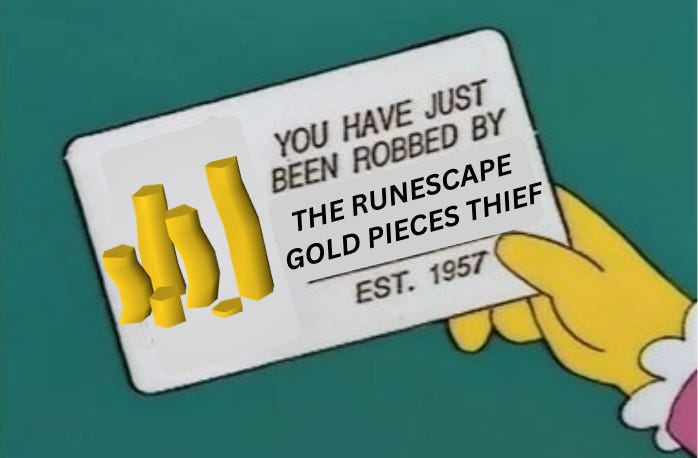
We examine an influential UK Court of Appeal ruling about pinching in-game currency
Steam set for a half-billion-pound class action lawsuit in the UK following Competition Appeal Tribunal ruling
Highguard barely enthuses in the week’s releases
Hello VGIM-ers,
Somehow, it’s the end of January already. But rather than dwell on time speeding past alarmingly quickly, I wanted to let you know about a few things coming up in the next three months at Osborn Towers.
In February, copies of Power Play will be unleashed in digital format to unsuspecting journalists, commentators, and bigwigs for endorsement purposes. If you’d like to have an early look at the book, get in touch.
Then in March, I’ll be doing something a little different to most years. I’m skipping GDC to have a couple of weeks off before the madness of launching a book kicks in. Expect to see some beloved freelance favourites in your inboxes then.
And in April…well, I can’t tell you what I’m doing then just yet. But stick with VGIM over the next couple of weeks, and you’ll find out what I’ve been cooking up soon enough.
The big read - Thou can steal (gold pieces)
Love thy neighbour: I get on well with my next-door neighbour, but she usually only texts me about a few things. Have I read anything good recently? Did I pick up a package for her? And how is her cat doing when I’m on cat-sitting duties? But last week, I received a message from her that unexpectedly brought our professional interests together.
Professional courtesy: As a very capable barrister, my neighbour likes to keep abreast of legal developments that might affect her day job. Last week, she spotted a write-up from law firm Norton Rose Fulbright of a video game-related ruling that she knew would catch my eye.
Property: In the catchily titled R v Lakeman case, the UK’s Court of Appeal ruled that Old School Runescape’s in-game currency, which is called ‘gold pieces’, counts as property and can be stolen under the country’s Theft Act. In doing so, it’s opened up the possibility of some intriguing - and genuinely impactful - changes to the law around in-game currencies in the UK and beyond.
You gotta heist, for your rights, to properrrr-tay
Alleged antics: The head-scratching about whether gold pieces count as property started with some allegedly seriously naughty behaviour from a former Jagex staff member. The ex-employee, who worked at the company as a content developer, allegedly accessed and emptied 68 player accounts holding a whopping 705bn pieces of in-game gold. He is then alleged to have sold the gold to ‘off-line’ buyers via a mixture of bitcoin and fiat currency (i.e. cash), putting him on course for potential ill-gotten gains valued at the better part of £550,000.
Theft defined: The alleged Danny Ocean of Old School Runescape was charged with several crimes, including a range of money-laundering offences and the wonderfully twee sounding misuse of computers. But at the heart of all these crimes was a charge of theft, which is defined in the UK by a 1965 act as when someone “dishonestly appropriates property belonging to another with the intention of permanently depriving the other of it.”
Missing the threshold: However, the defendant’s lawyers said that the theft charge should be dismissed on the basis that gold pieces don’t count as property. And a Crown Court judge agreed with them. While the judge did say that gold pieces met some key criteria to be counted as property (more on that in just a second), they suggested that the in-game currency lacked two key characteristics of other forms of property.
Heated rivalrousness: Gold pieces, they argued, were a form of digital ‘pure information’ because they could be infinitely created by the publisher and shared with players in a manner legally akin to someone sharing knowledge out loud. This meant that the asset lacked ‘rivalrousness’ – an economic term which means that the consumption of a good stops someone else from consuming it at the same time. This meant that gold pieces didn’t count as a nickable form of property, meaning that the theft charges should have been dropped.
Appealing outcome
Second opinion: Unsurprisingly, the prosecution appealed against the verdict. And after what reads like a lot of tedious legal to-ing and fro-ing, the case wended its way to the appeal court. There, the judges prodded the original judgment with a series of questions to work out whether they should be charged with theft. To save your sanity and reading a very long document, I’ve chunked them up into three lines of inquiry.
Outlining the arguments: The first was whether Runescape’s gold pieces meet four conditions of property known as the Ainsworth criteria, which means that they must be definable, identifiable by third parties, “capable in its nature of assumption by third parties” (i.e. tradeable) and have a degree of permanence. The second was to examine whether the original judgement was right to define gold pieces as ‘pure information’ that lacked that all-important rivalrous context. And finally, the appeal court judges had to answer whether emptying someone else’s account of gold pieces met the narrow criminal conditions of the Theft Act, which - as a reminder - is all about dishonestly depriving someone of their property.
Objects permanence: On the Ainsworth criteria, which were defined by a 1965 case and not by the current Gillingham manager, the appeal court agreed with the original judgement that they meet every criterion. The ruling asserts that gold pieces are “clearly definable and identifiable” by third parties. It states that gold pieces could be swapped by players in-game, making them capable of assumption. And while Jagex does have the right to yank gold pieces from players’ accounts or take the currency out of circulation, the judges stated that gold pieces have at least a degree of permanence for anyone who owns some. “A melting ice lolly or a burning match will qualify as property,” the ruling stated, inadvertently channelling the spirit of an Instagram influencer posting captions over pictures of tropical sunsets.
Clip it good: However, the Court of Appeal disagreed with the Crown Court judgment that gold pieces lacked the quality of rivalrousness. Although they did recognise that the production of gold pieces in a digital context is near infinite, they diverged from the original judgment by comparing the in-game currency to the production of paper clips. There is an essentially infinite supply of paper clips in the world. But if you own one and use it to hold together a stack of documents on a table, that “precludes its use or consumption by another.” The gold pieces in your Runescape account may be the thin end of an infinitesimally large currency edge, but they’re still your gold pieces to use as you see fit. And if that’s the case, they must be rivalrous because you holding onto them stops someone else from using them.
Function over form: Even more importantly than the stationery comparison, the judges drew a comparison with developing law around cryptocurrency to show that the important thing is not whether an asset is produced digitally; it’s how it functions in the world. Instead of fussing over how gold pieces are produced, the judges asked whether they had a visual and functional value in the world and whether that value is recognised in-game or through third-party markets. Drawing on guidance from the Law Commission regarding digital assets in general, they argued that gold pieces were recognised as having useful value and cash value due to the existence of those offline markets where players can flog currency. This, in their opinion, knocked away the ‘pure information’ argument.
Dishonest dealings: Therefore, the judges were able to head to the final question about whether pinching gold pieces from someone else’s account could amount to theft. Using the arguments they’d developed and drawing on other examples from across the world - including a legal case in the Netherlands which ruled that stealing in-game items was a form of theft - they said that it would be unsatisfactory if stealing Runescape gold “did not amount to the offence of theft.” The intention behind emptying someone’s account of gold pieces and flogging the proceeds online could therefore reasonably be seen as an attempt to dishonestly deprive someone of their property. This led to the conclusion that the defendant could be tried for theft, reversing the Crown Court judgment in the process.
All that glistens might be gold?
Caveats galore: For now, the ruling has a deliberately narrow application because the judges who presided over the case took great care to draw boundaries around it. While it did find that Old School Runescape’s gold pieces could be considered property in the context of a criminal charge of theft, they stated that this did not necessarily apply to wider civil law. They made it clear that the judgment only applies to the status of gold pieces in Runescape in this trial, not wider in-game purchases. The entire case was also understandably UK-centric, meaning it theoretically has little international applicability.
But, but, but: VGIM sources believe that the ruling has the potential to be influential both in the UK and the rest of the video game world. For starters, it puts into writing a lot of things that video game companies won’t necessarily like to see. It opens the door to suggestions that all in-game currencies are property. It suggests that their trade in offline grey markets for cash might give them real-world value, irrespective of what a game’s terms and conditions might say. And if both of these things are true, it could strengthen arguments around all kinds of consumer protection issues that game companies don’t want to talk about. This includes discussions over thorny issues such as whether loot boxes are gambling (because the contents of them may now be seen to have real-world value) or publishers finding fairer ways of “killing” their live service games (because users may try to argue that they have property rights over currency they’ve accrued in games).
On the cases: And though the ruling doesn’t currently apply beyond a narrow context, it establishes a legal building block for others to build upon. Even though the ruling notionally applies to narrow criminal law, Aaron Trebble of Lewis Silkin writes that the case’s “reasoning may apply equally to civil cases” – something that’ll encourage people to test its cash value conclusions in other contexts. Anna Poulter-Jones of Sheridans, meanwhile, says that companies should expect it to have broader implications because the Court of Appeal consistently draws on civil law examples to make its argument, reducing the likelihood that it can be seen as only relevant to criminal law. Whether or not this ruling is wielded successfully in a court of law to change the legal basis of in-game currencies or items, policymakers and campaigners will undoubtedly have taken notice of its conclusions. This means it may inspire wider political change, irrespective of the outcome of any future court-based ding-dongs.
Tightening net: For now, the main implication of the ruling is that an alleged wrong ‘un will go on trial for theft for pinching Runescape gold. But the Court of Appeal’s judgment could inadvertently lead to an even tighter legal environment around in-game currencies and purchases. Video game publishers would do well to brace themselves for the impact of this in the years to come.

News in brief
The heat is on: In further UK video game legal shenanigan news, Valve is set to face a class action lawsuit that claims its overly high revenue share has negatively impacted consumers across the country. The claim, which was filed back in 2024 by Vicki Shotbolt and is supported by David Zendle and Andy Burrows, argues that Steam’s 30% revenue share and market dominance have locked consumers into the platform - depriving the UK’s 14m PC gamers of up to £656m in the process. The CAT’s decision to allow the case to proceed (which is not the same as a ‘mini-trial’ in its own words) can be read in full here.
Ooh la-na: French publisher Ubisoft has announced it is restructuring into five creative divisions as it continues a hefty internal restructure. Each division will focus on a different vertical, with Tencent-backed Vantage Studios supporting its flagship franchises. The reorganisation has coincided with cutbacks and cancellations, including the canning of a Prince of Persia remake and the closure of Ubisoft Stockholm.
Not Stopping Stop Killing Games: Stop Killing Games is heading back to the European Commission for examination after it received 1.29 million statements of support from EU citizens. The campaign, which somewhat shakily claims it is just about preventing publishers from remotely disabling video games, will receive a reply from the Commission before 27th July 2026.
Plugging leaks: Take-Two is allegedly considering delaying the physical release of Grand Theft Auto VI in an attempt to prevent leaks, according to VGC. Its report is based on information from a Polish video game site with a track record of breaking industry stories, which suggests the publisher is planning to hold back physical copies of the game to ensure its contents remain secret until launch day.
Blast off for Mars: Finally, nearly 13m popped along to a Bruno Mars concert inside Roblox’s Steal a Brainrot experience. The event, which also achieved 10m livestream views across 14 countries, allowed attendees to grab their own limited-edition Brunito Marsito brainrot collectable. For the record, my brain rotted while writing that final sub-clause.
Moving on
Tom Stone has been promoted to Team Lead at Bastion…Karl Stricker is Chief Revenue Officer at Virtuous…Lee Guinchard has expanded his responsibilities at Embracer Group to become Chief Operating Officer…Monty Hernandez has been appointed as Strategic Operations Lead at Netflix, after spending over a decade working at Microsoft…And Michael Blank and Nicole Quinn have co-founded Connect Ventures…
Jobs ahoy
Electronic Arts is hiring an SVP, Publishing - EA Entertainment in Redwood City…Hangar 13 has a Narrative Director role going in Brighton…Quantic Dream has a rare Cinematic Director role available in Paris…Climax Studios needs a Technical Artist on a 12-month contract…And ACMI has the dream role of Melbourne International Games Week Coordinator going down under…
Events and conferences
Taipei Game Show, Taiwan - 29th January-1st February 2026
DICE Summit, Las Vegas - 11th-13th February 2026
Guildford Games Festival, Guildford - 14th February 2026
devcom leadership summit, Lisbon - 24th-26th February 2026
Game Developer Conference, San Francisco - 9th-13th March 2026

Games of the week
Highguard - Play the PvP shooter that received a surprising amount of hate at last year’s Game Awards is out now.
Earth Must Die - Point and click adventure featuring the cream of the British comedy crop (Tamsin Greig! Alex Horne! Other people!) lands on Steam.
Steel Century Groove - Elite Beat Agents meets Pacific Rim in this dancing mech extravaganza.
Before you go…
What happens when a beloved cultural institution asks you to pitch a game for their forthcoming exhibition? You make an in-person game about answering video game consumer hotlines, of course.
Hotline ‘93 is an interactive experience designed to recreate the thrill of answering phone calls from punters stuck on their favourite titles.
Yarn Spinner has the story of how it came to life and why Melbourne’s outstanding ACMI museum said hell yes to the idea.
Keep up with VGIM: | Linkedin | Bluesky | Email | Power Play |