

Young male gamers are twice as likely to believe conspiracy theories compared to the UK public, 25/06/2026
'Sceptical Scrollers' are also four times as likely to think they can spot misinformation 🤯

More in Common research explores how to help young male gamers deal with disinformation and misinformation
Steam Machine $1000+ price point sparks conversation and controversy
Star Fox swoops onto Switch 2 to save the day in the week’s release
Hello VGIM-ers,
What do you do when you’ve announced a book in the UK? You do it all again in North America, of course.
Yes, the US and Canada launch of Power Play is taking place on 21st July. And you’re invited to join me at two fabulous events in the Big Apple to coincide with the launch.
First, I’ll be speaking at this year’s Games for Change Festival. We’re firming up the session title, but you’ll be able to hear me speak about the book and buy a copy in the Festival’s bookstore on 21st and 22nd July. Get your ticket here.
Second, I’ll be joining the Thriving in Games Group for an evening of networking, cocktails and chatter as part of its Digital Thriving Salon series on the evening of 22nd July. Sign up here, pending approval from the TIGG team.
And finally, my publisher is running a special pre-order promotion in the run-up to US launch day.
Head to Globe Pequot’s website and use the code Preorder20 to get 20% off the hardcover price.
The big read - Gamers are twice as likely to believe conspiracy theories
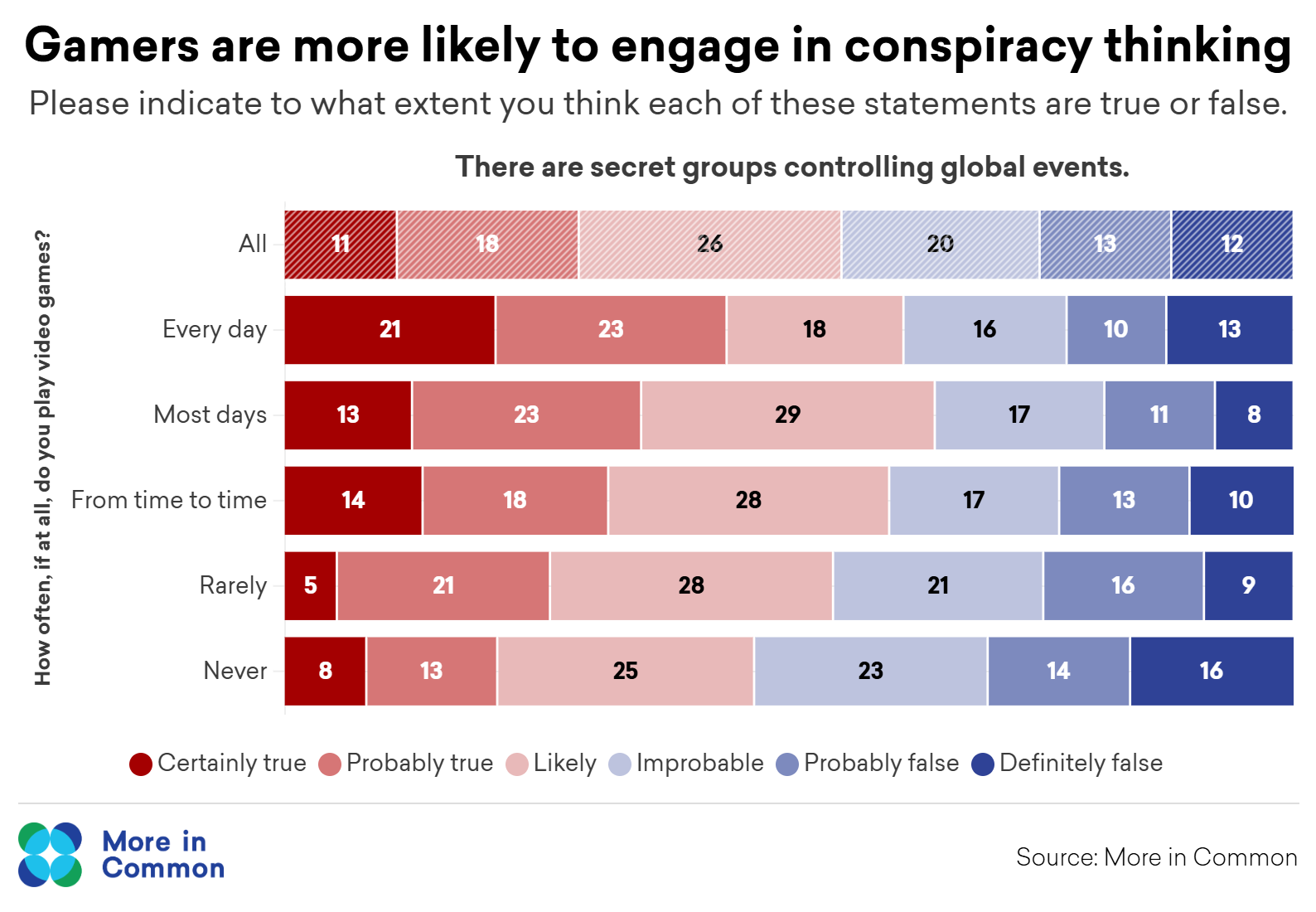
A concerning statistic: Young men in the UK who regularly play video games are twice as likely as the general population to believe conspiracy theories, according to a new report called On their terms: Countering disinformation through games from research firm More in Common and The AKO Storytelling Institute at the University of Arts London.
An unhealthy paradox: More in Common polled 2,000 Brits to unearth possible links between playing games and susceptibility to misinformation. Nearly two thirds (64%) of a segment of the sample dubbed ‘Sceptical Scrollers’ — packed with young men who love video games, but distrust the current political and news landscape — were inclined to believe conspiracy theories like “secret groups are controlling global events. This is despite stating that they were four times as confident as the average citizen to be able to spot misinformation.
Exclusive access: But who are these disaffected young male players? What about them makes them susceptible to misinformation and disinformation? And what can video game developers, influencers and communities do to strengthen their resilience in a complicated digital information environment? More in Common kindly gave me early access to its research findings and transcripts from four focus group interviews to find out more.
Meet the Sceptical Scrollers
Background information: More in Common and the AKO Storytelling Institute at the University of Arts London shared a common goal. They wanted to find novel, engaging ways to reach audiences vulnerable to misinformation and disinformation with effective interventions that address their needs. They identified that young men aged 16 to 24 were one of those groups. They had a strong hunch they loved games. And they thought they could be reached through them. But they needed some data to test their hypothesis before they set about designing games to try to influence them.
Defining the audience: To build an evidence base, More in Common polled 2,000 people and ran four focus groups recruited from one of the seven segments that it says shape British society today: Sceptical Scrollers. Accounting for 10% of the country’s population, Sceptical Scrollers are living a tough life. They are the lowest-income and lowest-wealth group identified by the research agency. They’re more likely to work second jobs, live in social housing, and be in debt than the rest of the population. They’re usually based in urban areas and are twice as likely to live less than two miles away from where they grew up. Importantly, 60% of Sceptical Scrollers are male and are, on average, six years younger than the UK as a whole – making them the perfect audience for this research.
Understanding the worldview: The group has a distrustful worldview. Sceptical Scrollers are more likely to say they have no trust in politicians and say that democracy is broken. They dislike discussing politics, with only 19% of the group saying they enjoy talking about it. They feel lonelier than any other group, with fewer friends to turn to in times of trouble. They also believe that the root of their problems is systemic, placing the blame for the circumstances they live in on society at large. “I quickly went off it [politics] when I saw how corrupt it was and how little, it’s sad, but how little influence that you had,” said Luke, a 28-year-old gamer recruited for one of the focus groups. “So now I try and stay away from it, if I’m honest.”
Alternative news sources: Despite Luke’s sincere dislike of politics, Sceptical Scrollers still get news. They just don’t get it in the places where we’d traditionally get information. The group is the least likely to watch terrestrial TV, listen to the radio or read a print or online newspaper, while also being the most likely to turn off if political news comes on air. They do, however, get information from people they trust on YouTube, via podcasts, or wider social media. And when these influencers speak about politics, Sceptical Scrollers end up listening to them.
The truth isn’t out there: Some of that news matches up with reality. One focus group participant called Daniel told a moderator that he had discovered that Donald Trump was planning to remove birthright citizenship in the United States via an executive order through his information ecosystem – something that is true. Others had to contend with falsehoods and conspiracy theories being shared within their digital networks by people they trusted. “My auntie thought the aliens were invading because of all the UFO sightings that were happening in the US,” said Shem, another participant. Realistic videos had convinced her that an X-Files-esque truth was out there. He had to try to convince her, and likely himself, otherwise whenever she phoned them up about it.
Play matters: Crucially, there’s one other digital medium that Sceptical Scrollers are more plugged into than the rest of society: video games. Of More in Common’s seven segments, people within the segment play more often than anyone else. They play for longer too, with 52% of the demographic playing for more than an hour at a time compared to 38% of the wider population. And they do so because games offer them something that their lives rarely do. The group, who are also the most likely segment of society to say they feel stressed, say they play games to disconnect, escape and relax. “You see how rich it is…you see the time and the effort…the heart that has been put into these games…,” says Jack, a 24-year-old Sceptical Scroller. “It gets you involved, it takes you off… even when you’re not playing the game, you are thinking about the game.”
The space between: So, Sceptical Scrollers play video games in large part because it allows them to escape the hardships of their day-to-day and immerse themselves in something else. But as we know from Power Play (what do you mean you haven’t read it all yet?!), video games sit at the heart of a thriving alternative information ecosystem that is largely unmonitored and uncontested by democratic actors. This allows a group already vulnerable to misinformation to be attacked via an entertainment medium intended for fun.
Influence games?
Lacking clarity: After polling 2,000 sceptical scrollers, More in Common discovered the alarming paradox that Sceptical Scrollers think they’re better at spotting misinformation while consistently falling for conspiracy theories. But how exactly do Sceptical Scrollers who love to play games end up in a place where they think they’re much better at spotting misinformation, while being significantly more likely to end up indulging in conspiratorial thinking? The answer, unfortunately, isn’t entirely clear.
Clash of ambitions: In the context of this research, which aims to help people who make games that teach players about misinformation do so more effectively, More in Common found a clash between a well-intentioned ambition and why Sceptical Scrollers play. “Many players value videogaming precisely because it is a space free of political ideology,” it argues. “Most treat games as an alternative to the moral, political and gritty reality they live in, and they want them to stay that way.”
Inconsistent outcomes: This means that efforts to educate directly through games can fall flat. More in Common tested two specially made games that teach players about misinformation through game mechanics: Solomon’s Secret, a narrative game about solving a mystery where your character is being manipulated, and Bezerkerz, a game that sought to teach players how their emotions could make them more susceptible to misinformation. The results were mixed. More in Common said that the games had “some success” with participants overall. But once the purpose of the game was explained to the groups, “a number of participants felt betrayed”. “I just don’t think gaming is a good medium to send that message,” said Gordon, one participant who reflected the group’s unease at games trying to influence their thinking.
Important insight: But while the games themselves didn’t land well, the transcripts of the focus groups show something I’ve written about for ages: how the digital information ecosystem surrounding someone who identifies as a gamer shapes their political world in a way that opens them up to influence. Luke, one of the participants mentioned earlier, produced a fascinating response to a question about being misinformed online by tying a reel he saw about supposed suppression of free speech in Germany back to content moderation policies in Call of Duty. “It’s an 18-plus, but you’re not allowed to swear and things like that. So it’s like, yes, alright, it’s not right to bully people online and so on. But I think instead of this police enforcement state online, which has a bit more, like, totalitarian aspects to it, there are other ways to do it.”
Leap of logic: He then jumps from being banned from swearing in a first-person shooter to the potential erosion of free expression. “And what if we want to show our political beliefs, but it goes against the mainstream media, then are we going to be punished for that? And what’s the next step once you start that ball rolling?” Luke’s next interjection, after a couple of comments from other attendees, was to question “the number of casualties from vaccines and stuff” in relation to the Covid pandemic: the kind of conspiratorial thinking identified by More in Common’s wider polling
Peeling the onion: Luke’s comments, I believe, give us a closer indication of how the inherent distrust and dissatisfaction of sceptical scrollers can be taken advantage of within the video game information ecosystem. Games themselves can shape how people think, provided they engage with them. But it’s the onion-like layers of social media platforms, in-game chat, and content wrapped around games that shape how this group sees the world they live in – both off and online.
Marinating in: And in the context of misinformation and disinformation, the ecosystem around games is, unfortunately, primed to weaken their defences. Much of ‘gamer’ culture amongst young men has marinated in conspiracy theories (e.g. the emergence of QAnon from the ashes of Gamergate), been shaped by actors in the far-right, or encouraged by political leaders whose populist narratives care more about stirring discontent than informing audiences (e.g. Adin Ross livestreaming with Donald Trump on Kick in 2024). This, I think, is why Sceptical Scrollers like Luke can make a quick jump from playing Call of Duty to sharing conspiracy theories and explains why the group may not respond well to games trying to inoculate them against misinformation risks.
Moving forward
Constructive solutions: More in Common’s research is disheartening to read at times, especially when I think about how the unhappiness of down-on-their-luck young men is being weaponised. Nevertheless, we should welcome the fact that research like this gets us much closer to understanding what’s going on in the lives of Sceptical Scrollers – especially when it gives us some hints on how to deal with it.
Game on: Fundamentally, the research shows us that video games play a remarkably positive role in Sceptical Scrollers’ lives. In a world where they feel disempowered, lacking in agency and disconnected from society, video games, their communities, and the information ecosystem around the medium plug them into community. It empowers them in a way little else does. They also love games for the same reason so many of us do. This creates common ground and allows us to meet them on their terms, as the title of the More in Common report suggests.
Take games seriously: What we need to do is contest the video game information ecosystem to reconnect Sceptical Scrollers to society and restore their trust, rather than allow them to be subtly directed towards cranky conspiratorial thinking. The first way this can be done is to do what More in Common and AKO have done: take video games seriously as an information landscape. This creates the conditions in which a joined-up civil society effort can reach Sceptical Scrollers, while increasing the chances of reaching them with effectively designed campaigns.
Give out your Papers, Please: Next, we can use some of the lessons from the research to design games that effectively communicate the risks around misinformation. As seen above, direct educational games are not likely to reach the audience unless there’s an obvious reason why they’d choose to play something like that as a way of getting information (e.g. choosing between an educational disinformation game or doing a workbook exercise at school). But games that encourage critical thinking, media literacy and discerning truth without getting preachy can reach Sceptical Scrollers, provided they’re built from the ground up for fun first. Social deduction titles like Among Us or Lukas Pope’s Papers, Please, the Soviet Union border crossing guard simulator par excellence, were not designed to tackle misinformation. But their mechanics usefully align with techniques needed to critique incoming information. Empowering indie developers to create these games with public funding and support is one of the report’s key recommendations.
Don’t get played: Finally, and outside of the report’s remit, I think there’s a clear need to contest the information ecosystem from within. This isn’t easy to do, given the disparate nature of the video game information ecosystem. That said, creating a campaign to combat misinformation and disinformation in games that is supported by industry and creators organically could act as a meaningful counter. By leaning into the space to ask people whether they’re being ‘played’, we can raise awareness of misinformation amongst a digitally savvy group who could naturally gravitate towards creators or communities who authentically reinforce the wider message. This is seen in one snippet of the focus groups, where one participant praises the YouTuber Miniminuteman for his work debunking pseudoscience and conspiracy theories to an audience of millions of people.
Wider lens: More in Common’s research initially focused on creating effective educational games about misinformation and disinformation for UK audiences. But it significantly strengthens the argument that we must treat games as an influential information ecosystem and space where citizens live, talk and form identities wherever you are in the world. And if you’re interested in creating a healthy democratic discourse online, helping Sceptical Scrollers who love to play to move away from conspiratorial thinking could have a major ripple effect across the digital world.
Read More in Common’s findings on its website here.

News in brief
Boiling price point: Valve has announced that its Steam Machine ‘don’t call it a Game Cube’ PC/Console thingy will retail for over $1000. The company said that the base retail price of $1049 is due to price volatility in the cost of memory and solid-state drives. It also said supply would be constrained, with devices dished out to consumers via a lottery. Thanks, AI industry.
Willing to take Less than Tencents: Bloomberg reports that Tencent is mulling multiple exits from Japanese studios such as Marvelous Inc. The Chinese giant is reportedly assessing whether to hold its minority stakes in a range of games businesses, with room to sell at a loss to management buyouts. The company’s focus is reportedly shifting towards user-generated content platforms and mobile investments made via MiniClip.
Cutting the Arabic chatter: Roblox has confirmed it plans to keep chat off in the majority of the Middle East until it improves its Arabic chat moderation. In an interview with Pocket Gamer Biz’s Isa Muhamed, Mohamed El Sheakh, General Manager for the region, said that efforts to moderate chat in Arabic fell well below the 98% accuracy rate recorded for English language moderation. The interview also covered Roblox’s potential economic impact on the region, while skirting a tricky question about lawsuits in America.
AppsFlyering-the flag: Interesting one this. Google, Unity, Meta and Moloco have teamed up to invest $1bn into AppsFlyer, a mobile marketing and attribution platform, at a valuation of $2.7bn. It is unusual to see rivals simultaneously invest in the same business. Eric Seufert explains lucidly why rivals have come together to back the business, preventing a crucial ‘neutral’ attribution technology from falling into private hands.
The Price is almost certainly right: And finally, Grand Theft Auto VI pre-orders open today. Rockstar has confirmed that the game will sell for $80, rising to $100 for the Ultimate Edition. It also said that people who buy the physical edition will receive a code with the game, rather than a disc.
Moving on
Zoher Toutanji is the Chief Publishing Officer at Crytek…Gareth Jandrell has been promoted to Senior Programme Communications Officer at Ukie…Jonny Taylor has been made Director of New Business, Create at Keywords Studios…Newzoo has a new CEO with Joris Goossens replacing Michelle Van der Wilk-Rouhof…And we’d like to express our condolences to friends, family and colleagues of Ubisoft co-founder Claude Guillemot, who died in a plane crash last Friday…
Jobs ahoy
Twitch is hiring a Senior Label Relations Manager to work with the music biz in New York…Netflix is recruiting a Researcher in its games team in LA…Supercell needs a Feature Lead in its London office…Electronic Arts is hunting for an Associate Manager, Esports Brand Marketing to work in East London…And Kwalee is scouting for a Game Scout in Australia…
Events and conferences
Develop, Brighton - 14th-16th July
VGIM Business Breakfast, Brighton - 15th July
Games for Change, New York - 21st-22nd July
ChinaJoy, Shanghai - 31st July-3rd August
Serious Play, North Carolina - 5th-7th August

Games of the week
Star Fox - Remake of the N64 classic with new-rootin’-tootin-scrollin’-space-shootin’ graphics takes off on Switch 2.
Deltarune - Fifth chapter of Toby Fox’s thoughtful parallel story to Undertale arrives surprisingly promptly across all platforms.
Dead or Alive 6 Last Round - Definitive version of a fighting game beloved by at least some people rounds off the week’s big releases.
Before you go…
So long, Sir Keir Starmer. Despite triumphantly winning a general election less than two years ago, Starmer has been putsched by his party.
Still, at least we have one final chance to see him in an environment he truly thrives in: a YouTube video about why SimCity doesn’t work properly when recreating UK cities.
…hang on.
Keep up with VGIM: | Linkedin | Bluesky | Email | Power Play |