

The Not-so-Great British Games Biz?, 26/03/2026
Jobs and companies are down and out in the UK, says TIGA 😬

New TIGA report paints a miserable picture for UK games biz
Epic Games lays off 1,000 staff as Fortnite falters
Footy-themed deckbuilder NUTMEG! is our self-indulgent pick of the week
Hello VGIM-ers,
It’s nice to be back in your inboxes. I’ve returned from Mexico considerably happier and much heavier than I was before. God bless tacos.
Before we dive into the big read, I wanted to remind you that we’re hosting the first-ever VGIM webinar on Tuesday 31st March in conjunction with Catalyst.
Now taking place at 3 pm UK time due to popular demand, we’ll be joined by Galen Lamphere-Englund, Dr Elizabeth Newbury, Dr Rachel Kowert, and Izzy Jagan to talk about building healthier video game communities.
After briefly introducing you to Catalyst and the work of the Christchurch Call, we’ll run through some new ‘digital bystander’ training for game professionals before rounding off with a chat about how to support the creation of positively playful communities. Lovely stuff, I’m sure you’ll agree.
The webinar is free to attend. Register for free here.
And finally, I wanted to let VGIM Insiders know that this month’s Debrief will be dropping at the top of next week instead of its usual final Friday slot.
Blame my sluggish, birria-blighted brain for the delay.
The big read - The Not-so-Great British Games Biz?
Uh-oh: The UK video games business is one of the longest-lived parts of the global games industry. It’s also in a wee bit of trouble.
Alanis Morrisette called: TIGA, one of the UK’s video games industry trade associations, has published a new report called Making Games in the UK. Somewhat ironically, it’s concluded that fewer people and fewer companies were making games in the UK in 2025 compared to 2024. Eep.
On the slide: According to its research, the sector’s workforce headcount fell by 4.5% from 28,516 to 27,347 between May 2024 and September 2025. The loss of 1,537 development jobs led to a further 2,810 roles lost across the wider supply chain, amounting to an estimated 4,347 job losses across the reporting period. For fact fans out there, that’s the first time that TIGA has recorded a decline in the UK games industry headcount over the past 14 years.
Bearing the brunt: The majority of job losses stem from what TIGA calls ‘larger studios’. Nearly 1,800 people working for studios with 15 or more staff were let go during the period, with nowhere near enough job creation elsewhere to make up for the fall. The association also reported that “almost every UK region lost development jobs”, with London (571), the South East (387), and Yorkshire (178) hardest hit.
Slowing start-ups
Trailing off: The decline in headcount across the UK games industry was matched by pretty supine business growth numbers. TIGA reported that the number of game development studios active in the UK has declined from a peak of 2,175 companies in 2023 to 2,110 businesses in 2025.
A little concerning: The downturn appears to be driven by two things. A total of 206 game companies closed down or left the games biz during the research period. By contrast, only 137 new video game start-ups were recorded over the same time. That’s considerably lower than the total of 281 start-ups recorded in the previous year and the worst figure recorded in 15 years.
A little optimistic: Admittedly, smaller game companies appeared to fare better than their larger counterparts. The smallest studios of between 1 and 4 employees nudged their headcount up by 3.2% over the period. Companies with 5-15 staff also saw their staffing count grow by 9.2% between May 2024 and September 2025. This supports the idea that nimbler game businesses have been better placed to weather an industry-wide realignment than their larger counterpart.
Lacking security: But despite the uptick amongst micro-businesses, job losses at bigger businesses still comfortably dragged the number of full-time employees across the UK games biz down. And while the number of freelancers serving the games biz in the UK climbed to 4,245 people, that figure itself paints a picture of the UK games business as less stable and less secure to work in than ever.
Policy problems
Strategic problems: Whether you’re based in Blighty or elsewhere in the world, you’ll agree that these are some yucky numbers. Unlike other parts of the world, the wavering fortunes of the UK’s games biz are a direct problem for the British Government. The sector was identified alongside the wider creative industries as a high-growth sector in June 2025’s industrial strategy. While it is undoubtedly true that public policy has a long tail and takes time to affect market conditions, these findings are bad news for a Government desperately pinning its hopes on economic growth to dig itself out of a financial hole.
Not exactly taxing: TIGA claims that the problem can be solved by pouring more money into the games industry. Alongside its trade association rival/frenemy Ukie, it argues that the baseline rate of Video Game Expenditure Credit - the country’s main form of tax relief - should be bumped to 39%. It also argues for a rate of 53% on projects valued below £23.5m. In both cases, it estimates that the measures would add in excess of 6,000 jobs and pay for themselves through increased tax receipts. While the first measure may be tougher to argue for in constrained financial circumstances, an enhanced credit for smaller game businesses would line up nicely with a similar credit for independent filmmakers. Equalising relief across the creative industries makes lots of sense.
A long list of problems: However, the suggestion that tax reliefs alone will arrest the slide in the UK games business doesn’t reflect the reality of a global realignment within the games industry. The sector’s traditional strength as a console games making market has turned into a weakness, with the previously affordable ‘razor and blades’ model withering considerably in the face of free-to-play mobile games and increasingly premium console costs. Western consumers have considerably less power to shape the future of the global games business, with China’s $50bn+ market dragging players, studios, and investment towards Asia. The consolidation of the video game publishing market into the hands of a few global supergiants has transformed many British businesses into supplicants, giving them little control over their destiny. Brexit made the UK considerably less attractive to international talent by significantly toughening up immigration rules, with the situation worsening every time a Nigel Farage-fearing Home Secretary opens their mouth. And the maturing of the games market in the West is leading to a structural change in the way the business works, leading to an environment where there is less space for larger companies with hefty full-time headcounts to support the sector.
Strategic storytelling
Traditional strengths: Therefore, the UK games industry needs more than just extra funding to climb out of the hole. It needs to reposition itself. The core strengths of the sector remain. There is an abundance of experienced game development talent in the country, as well as a rich seam of writers, performers, artists, and other creative professionals emerging from the rest of the country’s creative industries. It still has outstanding access to world-class professional services capable of setting up, securing funding for, and helping to grow games businesses. And even with the challenges of the self-imposed idiocy of Brexit, the UK’s literal geographic position as the English-language bridge to Europe (and the centre of global time) means we have natural trading advantages that national and global game businesses can benefit from.
Time for a game plan: But we will only hold onto this if industry and government pull together to create a coherent, realistic strategy for the sector to adjust to our new reality. Softening immigration policy, supporting scalability amongst games businesses to retain their independence for longer, empowering grassroots developers working on growing user-generated content platforms, providing targeted funding to the country’s local clusters, and folding the cultural power of the industry’s games into the UK’s wider soft-power strategy could provide a new story for the country’s games economy. In a year reportedly set to feature a new Bond game, the latest release in the Fable series, and a small title called Grand Theft Auto, it wouldn’t be a bad time to start telling one.
Pertinent question: But as with all established video game sectors around the world, the UK’s games industry must answer one question clearly: what does it want to be in a mature, increasingly specialised market whose centre of gravity is shifting away from its market? If it can’t provide a clear and realistic answer, there’s a risk that all the money in the world wouldn’t be able to stop the sector’s short-term slide from turning into a much bigger long-term problem.

News in brief
Epic losses: Speaking of job losses, Epic Games has announced it is laying off 1,000 staff. In a note to employees, Big Boss Tim Sweeney apologised for launching another round of layoffs, suggested that the main reason for the cuts was underperformance within Fortnite, and dismissed the notion that AI-related cost-savings were a factor. The company also quietly announced it was shuttering three Fortnite spin-off game modes: Ballistic, Rocket Racing, and Festival Battle Stage.
Sora point: OpenAI has said that it is shutting down its video-making app Sora. The BBC reports that the company claims that the move will allow it to focus on developing tools “that will help people solve real-world, physical tasks.” The decision has prompted Walt Disney to withdraw from a $1bn investment into the business. More pertinently for video game fans, Sora’s downfall has prompted a wave of gleeful Kingdom Hearts memes from people celebrating the service’s end.
Taking a ByteDance: Savvy Games has confirmed that it is set to buy ByteDance-owned games business Moonton for $6bn. The makers of Mobile Legends have been acquired by the Public Investment Fund-backed publisher, adding a Southeast Asia-focused mobile business to a portfolio which already includes Scopely and Niantic. Remind me what I was writing earlier about the centre of the global games business shifting towards Asia…
Robloxing brands in: Roblox is reportedly set to charge creators a fee for publishing brand integrations within its games, irrespective of whether a deal is signed independently. According to GamesBeat, Roblox’s brand team has tried to justify the move as part of its efforts to ensure that all experiences within the platform are transparent and age-appropriate. But with competition regulators across the world keen to test the openness of game stores and platforms, there’s a risk that the company may be about to walk itself into one of the first true competition tests of the user-generated content economy.
PEGI, He’s Keen: Finally, Bert Purchese at Eurogamer has written a lovely feature about Richard Wells, the voice of PEGI. He discusses Wells’ career, how he became the voice of PEGI, why the age rater bumped up his pay when the information world changed, and whether the line ‘PEGI 18’ is the most heard sentence in the world.
Moving on
Harry Smith has been appointed as an Associate at Reed Smith…Cathy Magnien-Ledesma is the Senior Director, Regional Marketing, Magic: The Gathering at Wizards of the Coast…Carmen Martino has been appointed People Operations Manager at PlayStack…Anny Gomes is the IP Strategy & Global Partnerships Lead at YoDo1 Games…And Jeff Simpkins has been hired as the National Team Manager for Great Britain’s Esports Nations Cup team…
Jobs ahoy
Apple is hiring a Business Manager Games, App Store, Central Europe, based out of Berlin…Unity is on the lookout for a Senior Video Content Developer…Netflix needs a Senior Manager, Games Licensing Operations…Roblox is recruiting a Senior Producer in San Mateo…And MrBeast apparently wants to recruit a Writer - Gaming…
Events and conferences
PAX East, Boston - 26th-29th March
London Games Festival, London - 13th-19th April
Games for Change Summit, London -15th April
gamescom Latam, São Paulo - 29th April - 3rd May
Summer Games Fest, Los Angeles - 5th-8th June
Games of the week
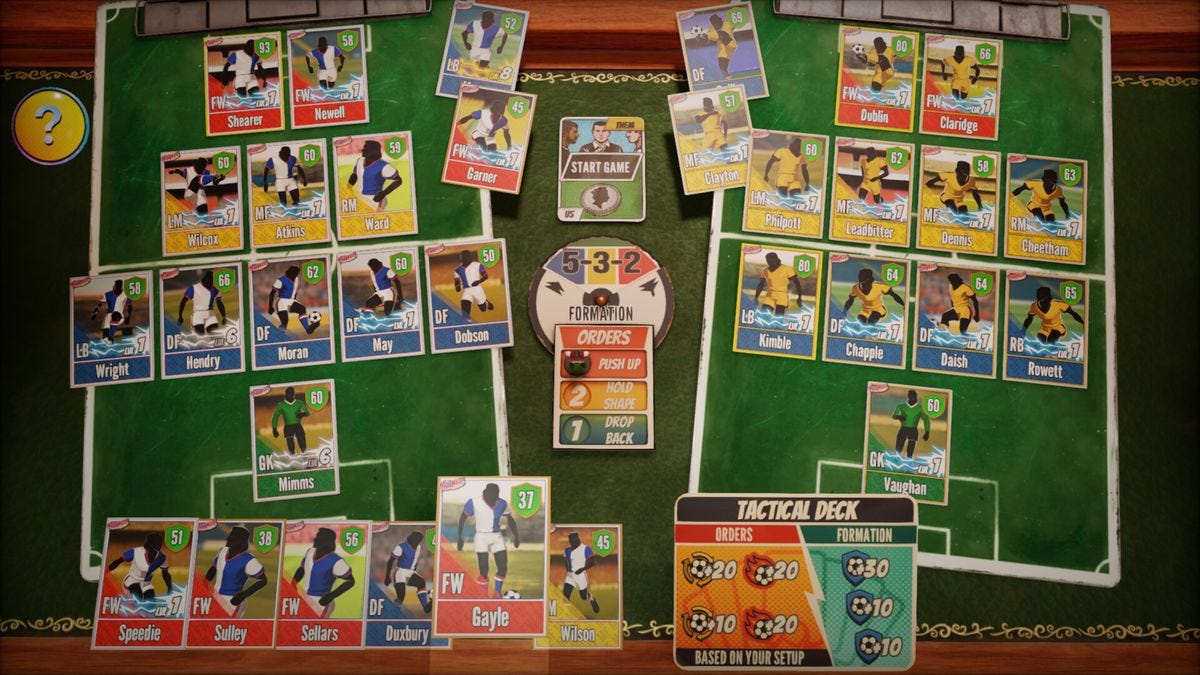
NUTMEG! - A 1980s/1990s football-themed deck builder? A trailer narrated by Jim Rosenthal? And it’s out on a Thursday in time for VGIM? Be still, my beating heart.
Super Mario Bros Wonder - Switch 2 edition of the game adds some perfectly passable DLC to a great game with only a handful of infuriatingly hard levels.
Life is Strange: Reunion - Latest entry in Square Enix’s long-running slice-of-life narrative adventure series arrives today.

Before you go…
The first tour date for the Power Play promotional tour has been announced. And it just happens to be at one of the biggest literary festivals in the world.
I’ll be speaking at the Hay Festival on Wednesday 27th May at 7pm to former foreign correspondent Robert Nisbet about the book and how video games are shaping geopolitics in surprising ways.
And if you do come along, you’ll have a chance to buy a copy of the hardback a full three weeks before launch. Lovely stuff, eh?
Tickets are available for £16 here, if you fancy coming along.
Keep up with VGIM: | Linkedin | Bluesky | Email | Power Play |